
Methodology
Context
Marketplaces selling social media accounts, comments, likes, and shares thrive, enabling online manipulation and influence. Nowadays, many online platforms require SMS verification to register an account in order to verify the authenticity of the person behind the account. However, this verification is frequently circumvented by the operation of 'farms' with thousands of SIM cards and virtual phone numbers, allowing buyers to register social media accounts automatically and in bulk.
To illustrate the level of automation in this industry, €10 can buy: 90,000 fake views, 10,000 likes, or 200 comments:
A parallel market for social media accounts has also emerged: rather than registering and verifying their own accounts, buyers can instead purchase accounts that are already pre-registered, verified, and sometimes aged, from sellers operating at scale. These ready-made accounts provide buyers with an alternative route to acquire inauthentic accounts, though many of these accounts either include or still require SMS verification.
Summary
The Cambridge Online Trust & Safety Index (COTSI) tracks the dynamics of two related manipulation supply markets across different platforms and countries: the market for fake SMS verifications, and the market for pre-registered social media accounts. For both markets, the Index aims to answer the following questions:
- How easy (and cheap) is it to engage in online manipulation?
- Is the situation with fake accounts improving or worsening over time?
- Which online platforms are most (or least) effective at combating manipulation?
- Which countries or regions are in higher demand for online manipulation?
By providing a comprehensive database and interactive visualisations, we enable researchers, governments and the general public to make data-driven decisions to combat misinformation and foster trust in digital environments.
Data: SMS verifications
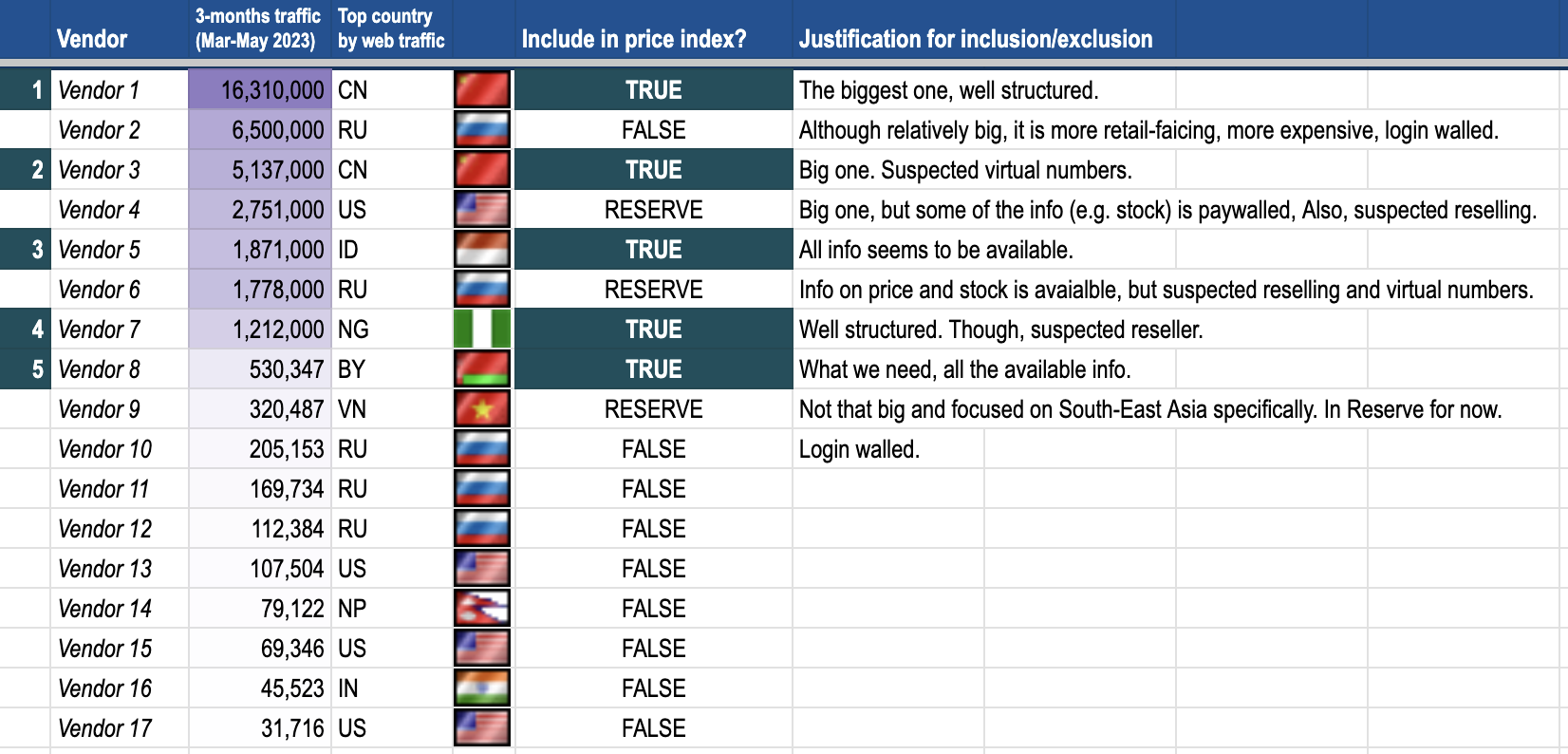
We identified seventeen vendors providing fake SMS verification services and sorted them by the web traffic they receive, focusing on the top 10. From this top ten list, we selected five vendors to be included in the price index. The justifications for inclusion in the price index are as follows: data on both price and stock should be freely available via API, preferably without login or paywall; and the sms verifications should be of comparable quality to the rest of the vendors.
| Vendor | 3-month traffic (Mar-May 2023) | Top Country by web traffic | Include in price index? | Justification for inclusion/exclusion |
|---|---|---|---|---|
| Vendor1 | 16,310,000 |  CN CN |  | The biggest one, well structured. |
| Vendor2 | 6,500,000 |  RU RU |  | Although relatively big, it is more retail-facing, more expensive, login walled. |
| Vendor3 | 5,137,000 | CN | | Big one. Suspected virtual numbers. |
| Vendor4 | 2,751,000 |  US US | reserve | Big one, but some of the info (e.g. stock) is paywalled, Also, suspected reselling. |
| Vendor5 | 1,871,000 |  ID ID | | All info seems to be available. |
| Vendor6 | 1,778,000 | RU | reserve | Info on price and stock is available, but suspected reselling and virtual numbers. |
| Vendor7 | 1,212,000 |  NG NG | | Well structured. Though, suspected reseller. |
| Vendor8 | 530,347 |  BY BY | | What we need, all the available info. |
| Vendor9 | 320,487 |  VN VN | reserve | Not that big and focused on South-East Asia specifically. In Reserve for now. |
| Vendor10 | 205,153 | RU | | Login walled. |
| Vendor11 | 169,734 | RU | | |
| Vendor12 | 112,384 | RU | | |
| Vendor13 | 107,504 | US | | |
| Vendor14 | 79,122 |  NP NP | | |
| Vendor15 | 69,346 | US | | |
| Vendor16 | 45,523 |  IN IN | | |
| Vendor17 | 31,716 | US | |
Our automatic script collects data via API interfaces provided by most vendors. The collected data consists of the price of verification and the number of verifications available, which are usually unique for a combination of a country and an online platform.
Data: Social Media Accounts
We identified five vendors reselling pre-registered social media, email, and messenger accounts by searching the phrase "buy social media accounts" on Google in several languages and while connected to VPNs located in several locations across the world. We selected 5 vendors which had the most complete public listing data on price and stock, prioritizing those with high estimated network traffic and diverse locations, comparable in quality to the vendors in our SMS-verification index. These vendors list products in English, Russian, and Chinese, pricing accounts in USD, RUB, and CNY.
| Vendor | Language | Listing currency |
|---|---|---|
| accs-shop.com | Russian | USD |
| AccsMarket.com | English | USD |
| buy-accs.net | English | RUB |
| dark.shopping | Russian | RUB |
| zhanghaoya.com | Chinese | CNY |
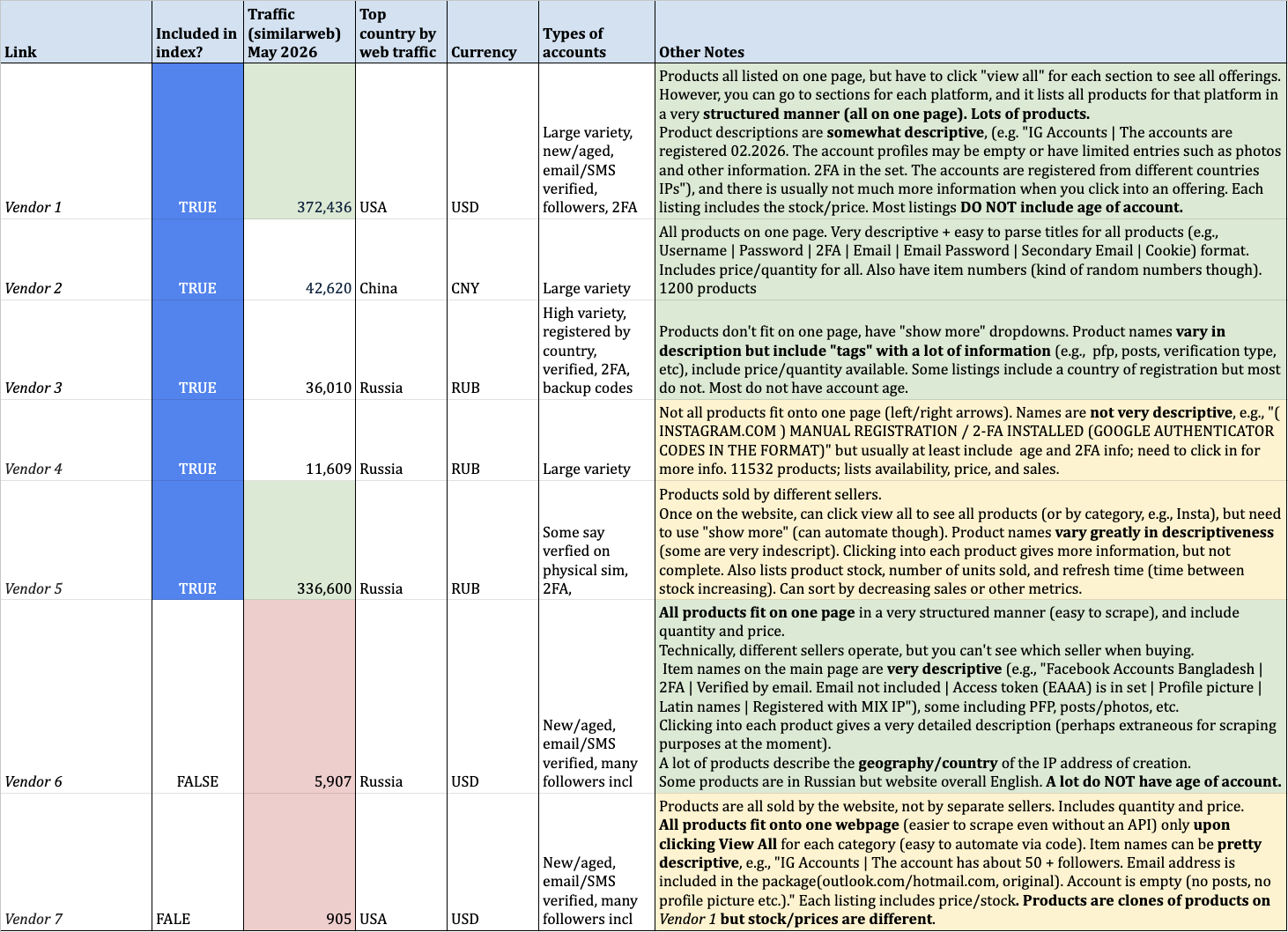
Our automated collection scrapes each vendor's public account catalog once daily, gathering the raw listing text and price for accounts currently for sale. No login, registration, or purchase is required to access this data, and we do not interact with checkout, payment, or account-management pages.
A large language model (Qwen3-8B-AWQ) parses each unstructured listing into structured fields: the platform the account is for, its verification method (SMS and/or email), whether two-factor authentication is enabled, its estimated registration country and age, and other characteristics that may affect its price. An account's registered country is inferred from whatever the listing states about its origin, often a phone country code, sometimes an explicit country name or a claimed registration location; ambiguous or multi-country listings are grouped as "mixed," and listings with no country information are labelled "unknown."
Prices are converted to USD at the time of collection, using the Central Bank of Russia's official daily rate for RUB and European Central Bank reference rates (via Frankfurter) for other currencies.
Two of our five vendors draw on overlapping supplier inventory and frequently list identical accounts. To avoid double-counting, listings longer than 30 characters that share an identical title on the same day are deduplicated, keeping only the lowest advertised price.
Data Collection Ethics
Our data collection is limited to publicly accessible marketplace listings: the same information any visitor can see without registering, logging in, or making a purchase. We do not create accounts, complete transactions, or access personal, payment, or account-management data on any vendor.
Our scrapers request pages at a deliberately slow, randomised pace to avoid placing meaningful load on vendor infrastructure, and respect each site's published robots.txt policy. Where a site's technical restrictions are ambiguous or unavailable, we apply an equivalent standard of restraint, avoiding sensitive account- and payment-related paths regardless.
The structured fields we extract and publish (platform, verification status, price, stock, and similar categorical attributes) never include personal identifiers such as names, emails, phone numbers, or account credentials. We do not process data in a way that identifies or targets any individual, and the Index itself publishes only aggregate, de-identified market statistics.
Representation
Online platforms. The list of online platforms available for fake verifications includes popular social media platforms such as Facebook, Instagram, TikTok, WhatsApp, and Telegram; cloud infrastructure providers such as Amazon Web Services, Google Firebase, and OpenAI; marketplaces; online banks; crypto exchanges; and more.
Countries. SMS verifications and social media accounts are available for purchase in almost every country. Hereinafter, we use country, economy, and region interchangeably, as defined by the World Bank classification: “The term country, used interchangeably with economy, does not imply political independence but refers to any territory for which authorities report separate social or economic statistics”.
In our context, these terms refer to regions operating independent mobile carrier networks. For the Social Media Accounts dataset specifically, "country" refers to an account's inferred country of registration, drawn from whatever the listing itself states about the account's origin, rather than a strict mapping to independent mobile carrier network regions. Listings describing multiple or ambiguous countries are labelled "mixed"; listings with no country information given are labelled "unknown." The full list of online platforms and countries observed by the index is available via the link: COTSI Services and Countries
The index data representation is organised as follows. This page covers both markets in turn, SMS Verifications first and then Social Media Accounts; each has its own selector menu, comparison table, and set of visualisations on its respective dashboard, described separately below.
SMS Verifications
Selector menu:- Allows choosing either an online platform or a country view mode.
- Displays the total number of verifications available for the selected platform or country across all monitored vendors of fake SMS verifications.
- Contains information on the average price for one SMS verification.
- The average price is calculated as a weighted average, weighted based on the number of verifications available.
- By Platform. Up-to-date statistics for a selected online platform:
- Map. Displays the gradation of prices or available stock, depending on the selected sorting criteria. The default view shows price gradation.
- Scatterplot. Depicts the distribution of countries by verification prices and stock with both axes set to logarithmic scales to allow better comparison despite outliers.
- Timeline. Compares historical data of verification prices and stock across up to 5 selected countries.
- By Country. Up-to-date statistics for a selected country:
- Map. Provides a zoomed-in view of the selected country, with click-through capability to see statistics of neighbouring countries.
- Scatterplot. Depicts the distribution of platforms by verification prices and stock with both axes set to logarithmic scales to allow better comparison despite outliers.
- Timeline. Compares historical data of verification prices and stock across up to 5 selected platforms.
Social Media Accounts
Selector menu:- Allows choosing either a platform or a country view mode, including an All Platforms / All Countries option that aggregates across every platform or country we track.
- Displays the total number of listings available for the selected platform or country across all five monitored vendors.
- Contains the average price for one account and the number of listings - the true number of distinct accounts observed, not the stock figure sellers self-report (which is often inflated and isn't used for pricing or ranking).
- The average price is a weighted average, weighted by the number of listings.
- By Platform. Up-to-date statistics for a selected platform:
- Map. Displays price gradation by country; selecting "All Platforms" zooms out to show the whole map.
- Scatterplot. Depicts the distribution of countries by account price and listings, with both axes on a logarithmic scale to allow better comparison despite outliers.
- Timeline. Compares historical price and listings data across up to 5 selected countries, plus an overall weighted-average price shown alongside the per-country figures when hovering.
- By Country. Up-to-date statistics for a selected country:
- Map. Provides a zoomed-in view of the selected country and its neighbours. The single figure shown as the "price" for a country in this view is calculated as the average of each platform's median price, weighted by that platform's number of listings, excluding the "other" category. Countries which have listings for fewer than 4 platforms or fewer than 20 total listings, excluding the "other" category, are not included in this view.
- Scatterplot. Depicts the distribution of platforms by account price and listings, with both axes on a logarithmic scale.
- Timeline. Compares historical price and listings data across up to 5 selected platforms.
Mission
The COTSI mission is to provide comprehensive real-time monitoring of online trust and safety metrics, focusing on the market for fake accounts and engagement, with the broader aim of countering misinformation and online manipulations.
The initial focus was monitoring prices of fake SMS verifications; the index has since expanded to track the resale market for pre-registered social media accounts, with further areas impacting online trust and safety planned.
Team
The Cambridge Online Trust & Safety Index (COTSI) is maintained by the Cambridge Social Decision-Making Lab with the development support of Trementum. The index's authors are Dr Anton Dek, Prof Sander van der Linden, Dr Jon Roozenbeek, Yara Kyrychenko, Kyrylo Manakhov, and Valentyn Bielavin.
The initial data collection pipelines and visualisations for the Social Media Accounts section were developed by Claire Chen and Miriam Lubashev.
UK Government Cabinet Office, Grant #SCH-00001-3391

Cambridge Centre for Finance, Technology & Regulation

Changelog
31 July 2024: version 1.0.0. published. This version features daily updated data on fake SMS-verification prices and stock, covering 546 platforms and 198 regions.
28 July 2026: Social media accounts methodology added. This version tracks the resale market for pre-registered social media, email, and messenger accounts across 5 marketplaces, 20 platforms, and 219 countries and territories.